All THAT YOU WANT TO KNOW ABOUT PAIN INTERVENTIONS!
Let us understand some facts about two basic pain procedures performed for the common problem of back pain. These are performed, by a trained Pain Specialist, by a specialised minimally invasive technique under local anaesthesia +/- sedation in operation theatre with real time X-ray guidance. There will be no cut or stitches as these are percutaneous.
Epidural injections (also known as transforaminal epidural injections/Nerve Root block)
Epidural steroid injections are an option that are typically used to treat lower back pain and leg or neck and arm pain usually caused by pinching and swelling of one or more nerve roots called radiculopathy( also known as sciatica for pain in the legs).
There are different routes to reach the target in a precise manner. Your doctor will decide which specific route to get the best possible outcome in your case.
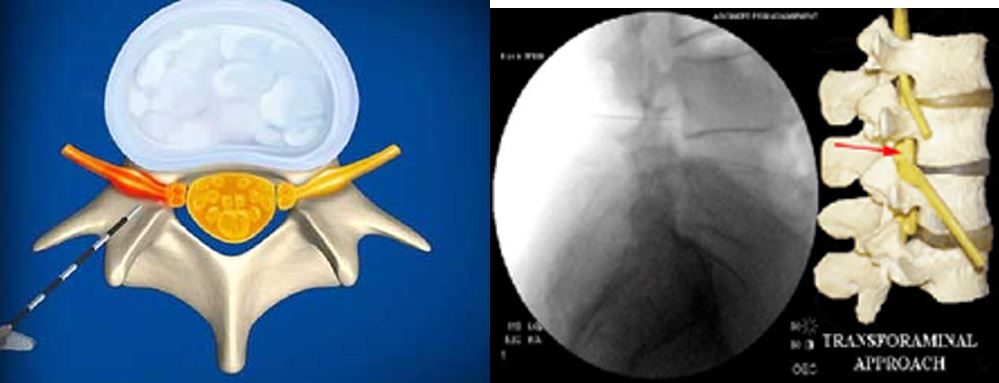
What is a Transforaminal epidural steroid injection (TFESI)?
A Transforaminal is the injection of a steroid and local anaesthetic medication into the epidural space by a special approach for better delivery in proximity of the inflamed nerve root.
What are Facet Joint Injections and Medial Branch Blocks for back pain?
Facet joint is a joint between two adjoining pieces of bone (vertebrae) of the spine on the back side. It is responsible for facilitating movements of the spine like bending, turning etc and also to provide stability to the vertebrae. Facet joint is a common cause for back pain and neck pain (about 15% of the young and 40% of the older population).
If diagnosed correctly by your doctor, it can be effectively treated in a minimally invasive manner by a Pain Physician. As neck and low back spine are two most mobile regions of the spine, their facet joints are more commonly subjected to the aging process and wear and tear.
If your treating doctor suspects clinical diagnosis of facet joint related pain, it will need to be confirmed by diagnostic block which is a gold standard.
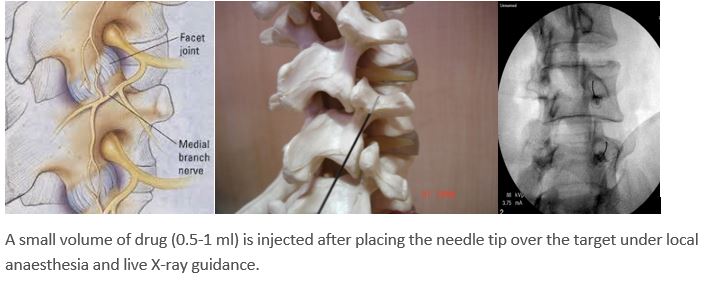
A small volume of drug (0.5-1 ml) is injected after placing the needle tip over the target under local anaesthesia and live X-ray guidance.
If the facet joints that were treated are the source of the pain, the patient will have immediate pain relief from the local anaesthetic and may begin to notice pain relief from the steroid after 2-3 days which improves over the next couple of weeks.
If the patient has immediate relief with the numbing medication, but does not have any longer lasting improvement with the steroid, further testing (medial branch nerve injection) or long-term treatment (radiofrequency neurotomy) might be performed. Protocols can vary for each centre but some do two testing blocks before offering long-term treatment such as RF or cryo ablation.
If the patient does not have any relief with the numbing medication, further diagnostic tests may be needed to explore some other source of the pain.
At our centre patients are instructed to record the levels of pain relief during the first few hours, and during the next several days, in a pain chart. A pain score chart is helpful to clearly inform the treating physician of the injection results and in planning future tests and/or treatment, as needed.
What are the instructions before the pain relief procedure?
- Do not eat or drink anything 4 hours before the procedure, except for a small amount of water if needed to take medications on the day of the procedure.
- If you take any blood thinning medications or antiplatelet medications, these must be stopped 7 days before the procedure.
- You will need to get some basic blood tests and RTPCR done before the procedure as per your doctor’s instructions.
- This procedure is by and large done on an outpatient or day-care basis which involves hospital stay for 4-5 hours
- Please carry all your relevant reports (including X-rays / MRI scans/CT scans ) when you go for the procedure
- On reaching the hospital room, you will need some preparation such as changing into clean OT clothes, clinical evaluation, consent after explanation of the procedure and an IV line
How is the procedure performed?
- These procedures are always performed in the sterile environment of operation theatre.
- Your doctor will guide you throughout the procedure with the steps.
- You will be required to sleep on your stomach on the procedure table with the comfort of pillows under the chest and hips.
- The injection site will be prepared with antiseptic solutions after ensuring your comfort.
- First the doctor will numb a small area of skin around the injection site with a local anaesthetic. At this point, you may feel a small amount of burning or stinging.
- Your doctor will then use live action X-ray called fluoroscopy guidance to direct a special needle to the targeted deeper area. You may feel some pressure or discomfort in your back or leg due to the pressure of the medication going around the nerve.
- Then doctor will first inject a contrast dye on the target to confirm that the needle tip is in the right place. Once placement is confirmed about 2 ml of medication which contain local anaesthetic and steroid is slowly injected into the epidural space.
- The procedure may be repeated at each targeted level.
- The needle is then removed, a dressing is placed on the insertion site, and you will be taken to the recovery area for observation.
- If you are nervous, a small dose of sedation may be administered by an anaesthetist to make you comfortable during the procedure, though most patients do not need it.
What are the discharge instructions?
- You will be monitored for about half an hour in the recovery room after the procedure to monitor your vital signs and observe any effect of the procedure on your recovery.
- You may resume your normal diet immediately or within 2 hours if you are given sedation.
- You will be discharged once you have passed urine and numbness in the legs, if any has recovered.
- You will be required to rest in the bed on the day of the procedure except walking up to the washroom or dining table, once all numbness in leg/ legs has recovered.
- Do not engage in any strenuous activity for 24 hours.
- You should be able to return to normal activities from the following day.
- You may be given a pain score chart, where you need to record your pain level on a scale of 0-10 for first two weeks and hand over to your doctor at two week follow-up.
What are the side effects?
Most patients have a smooth recovery after the procedure .Few may experience any of the following side effects up to 4 hours after the procedure. They are not dangerous and will resolve on their own.
- Mild soreness at the injection site can occur. This may persist for a couple days. If this occurs, take medicines like paracetamol or an anti-inflammatory medication as prescribed by your doctor or/and apply ice pack for 15 min to the injection site area.
- Heaviness or numbness in one or both legs may occur due to the local anaesthetic affecting the nerves that control your legs (this is a temporary effect and it is not paralysis).Your leg strength will return slowly and completely by itself.
- Dizziness may occur due to a decrease in your blood pressure. If this occurs, remain in a lying position. Gradually sit up, and then stand after at least 10 minutes of sitting once it settles.
- Initial mobilisation up to the bathroom or dining table should be attempted with some helper initially in case you feel numb in the legs.
What are the potential complications?
In almost all cases, the procedures go well and without any major side-effect or complication especially with a trained and experienced doctor.
- Serious complications of the procedure are extremely rare and include bleeding, infection, and nerve damage.
- Patients who develop severe back pain (different than your usual symptoms), new numbness or weakness in the legs, redness/swelling/ discharge at injection site, fever, or difficulty with urinating after a spinal procedure are requested to call the doctor and go to an emergency room for immediate evaluation.
- In less than 0.5 % of cases, the needle may puncture the dura, and this may result in a spinal headache, which is uncomfortable, but treatable. Drink fluids and take pain medications if needed. If the headache persist or become severe, call the doctor.
- You may have an allergic reaction to any of the medications used. If you have a known allergy to any medications, especially x-ray contrast dye or local anaesthetics, notify our staff before the procedure takes place.
How long does it take for the procedure to work?
Your back may initially feel sore for 2 to 3 days following the injection due to manipulation along the needle path. The steroid medication begins to take effect in 48-72 hours at which point you should start to see some benefit. The pain relief will continue to improve slowly with the peak effect occurring at about two weeks. Thereafter, the effect will stabilize and should last several weeks to months.
Follow-up :
Most patients will be generally called at two weeks after the procedure with discharge summary.